
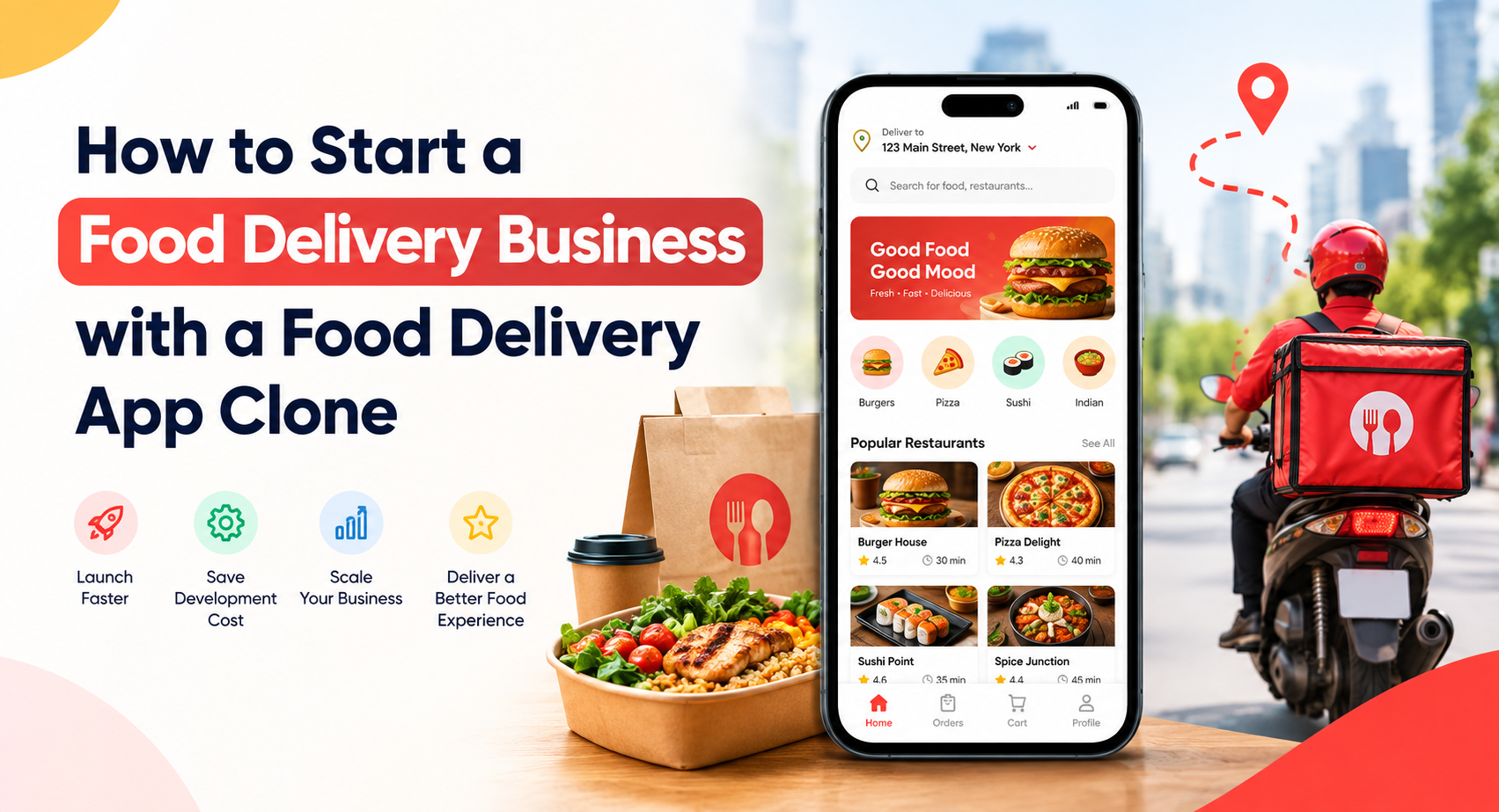
The food delivery industry has evolved into a highly competitive digital marketplace. Restaurants increasingly seek online visibility, while customers expect convenient ordering, digital payments, and real-time delivery updates. For entrepreneurs, launching a food delivery platform can create a compelling business opportunity.
A food delivery app clone provides a practical foundation for entering this market without developing every component from scratch. With suitable customization, branding, and business strategies, entrepreneurs can create a platform tailored to a specific market.
Understand the Food Delivery Business Model
Before investing in technology, determine how the platform will operate. A typical food delivery marketplace connects customers, restaurants, and delivery partners through a centralized digital ecosystem.
Customers browse restaurants, select meals, place orders, and track deliveries. Restaurants receive and manage orders, while delivery partners handle pickup and fulfillment.
The business can operate through several models, including restaurant commissions, delivery charges, customer service fees, advertising, subscriptions, and promotional partnerships.
Choose the Right Food Delivery App Clone
Building an application entirely from the ground up can require substantial development time and resources. A clone solution offers a pre-built foundation containing commonly required marketplace components.
The platform can be customized with a unique brand identity, interface, pricing structure, geographic coverage, and additional functionality. This approach can accelerate deployment while providing room for differentiation.
The objective should not be to replicate another company's identity. Instead, the clone should serve as a technological framework for developing an independent food delivery marketplace.
Include Essential Features
A robust platform requires separate interfaces for customers, restaurants, delivery partners, and administrators.
Important customer features include:
-
Restaurant discovery and search
-
Digital menus and food categories
-
Cart and order management
-
Multiple payment options
-
Real-time order tracking
-
Ratings and reviews
-
Push notifications
-
Coupons and promotional offers
Restaurant functionality should support menu management, order processing, earnings tracking, availability controls, and customer insights.
Delivery partners need features such as order acceptance, navigation, delivery status updates, earnings information, and delivery history. The administrator dashboard should provide centralized control over users, restaurants, payments, commissions, promotions, and platform analytics.
Launch the Food Delivery Business
Begin by researching the target market. Analyze restaurant density, customer preferences, delivery expectations, competitor offerings, and potential service gaps.
Next, select a focused launch area rather than attempting immediate nationwide coverage. Partner with restaurants that offer popular cuisines and reliable service.
Customize the food delivery app with your branding, configure operational settings, integrate payment gateways, establish delivery policies, and conduct comprehensive testing before launch.
A limited geographic rollout can reveal operational bottlenecks before expansion.
Develop Multiple Revenue Streams
A food delivery marketplace can generate revenue through several channels. Restaurant commissions are one of the most common approaches, where the platform retains a percentage of each completed order.
Additional possibilities include delivery fees, customer convenience fees, restaurant subscription packages, featured listings, sponsored placements, and loyalty programs.
Diversifying revenue can provide greater commercial resilience than depending on a single income source.
Market the Platform
Customer acquisition and restaurant acquisition should progress simultaneously. Digital advertising, social media campaigns, introductory discounts, referral programs, and localized promotions can help attract early users.
Restaurants can be encouraged to join through introductory commission rates, promotional visibility, onboarding assistance, or dedicated merchant support.
Local SEO is also valuable. Optimized restaurant pages, location-based content, and targeted search campaigns can help capture users actively searching for food delivery services.
Scale Strategically
Once the food delivery app clone establishes consistent order volume, expansion can begin systematically. New neighborhoods, cities, restaurant categories, and delivery zones can be introduced based on operational capacity and demand.
Analytics should be used to monitor order frequency, customer retention, delivery times, cancellation rates, restaurant performance, and acquisition costs.
Automation, scalable cloud infrastructure, personalized recommendations, and intelligent dispatch mechanisms can further improve operational efficiency as the marketplace grows.
Conclusion
Starting a food delivery business with a clone app involves more than launching software. It requires a viable business model, reliable restaurant partnerships, efficient delivery operations, thoughtful marketing, and continuous optimization. A customizable solution from SpotnEats can provide the technological foundation for entrepreneurs seeking to establish and scale their own branded food delivery marketplace.


 English
 Slovenčina
 Deutsch