

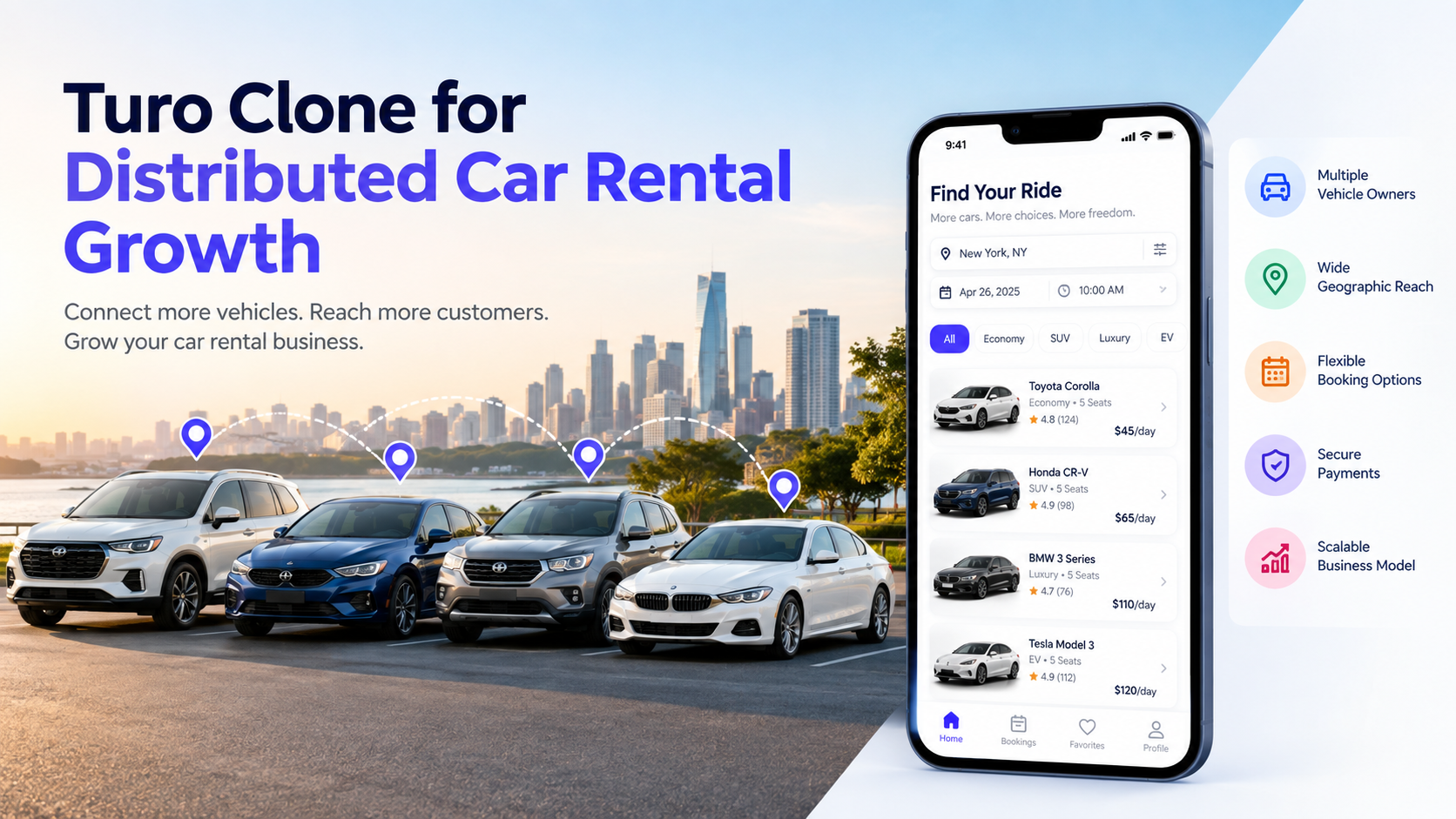
A Turo Clone becomes particularly valuable when a rental business has the opposite problem from what most people expect: it has vehicles, but they are not always in the right place at the right time.
Imagine a regional operator managing 60 cars across several neighborhoods. Monday demand is concentrated near business districts. Friday demand shifts toward airports and tourist areas. During local events, specific vehicle categories disappear from availability within hours. Yet several cars remain parked elsewhere.
Buying more vehicles doesn't necessarily solve that imbalance.
The bigger opportunity is coordinating distributed vehicle supply with changing rental demand.
That is where a marketplace-led car rental model becomes interesting for mobility entrepreneurs in 2026.
Turo Clone App for Distributed Vehicle Supply
Instead of treating every vehicle as company-owned inventory, entrepreneurs can create a network where independent owners, small fleet operators, and rental businesses contribute vehicles to the marketplace.
The platform becomes the coordination layer.
Owners can publish vehicles, define availability, adjust pricing, receive booking requests, and manage upcoming reservations. Customers get access to a broader selection without depending on a single rental branch.
For the platform operator, this creates an alternative path to expansion.
Adding supply doesn't necessarily mean purchasing another batch of vehicles. The marketplace can grow by onboarding existing vehicles that are underutilized.
That changes the growth equation.
A business could begin with a focused segment—such as economy cars in one city—and gradually add SUVs, premium vehicles, electric cars, airport rentals, or long-duration options as demand develops.
The technology becomes the infrastructure for organizing that supply.
When Idle Inventory Becomes the Real Growth Problem
Car rental businesses often think about utilization as a fleet metric. A marketplace can treat it as a network problem.
Consider two vehicles:
-
Vehicle A is available for five days but receives no booking.
-
Vehicle B is in the same city but receives multiple requests for overlapping dates.
Simply adding more vehicles doesn't fix this imbalance.
Better visibility into availability, pricing, booking patterns, and location can help operators understand where supply is underused and where demand is concentrated.
A modern Turo Clone can support this operational layer through availability calendars, booking management, location-based vehicle discovery, pricing controls, owner dashboards, customer management, and centralized administration.
The result is not merely a larger vehicle catalog.
It is a more coordinated supply network.
Advance Bookings Change the Marketplace Equation
Another important scenario involves customers planning trips weeks or months ahead.
Airport travel, holidays, weddings, corporate travel, and seasonal tourism can create predictable periods of high rental demand. If vehicle owners only respond when a customer searches, valuable future demand can remain difficult to capture.
Advance booking functionality changes that.
Owners can make vehicles available for specific future dates, while customers can reserve suitable vehicles before demand peaks. Platform operators gain greater visibility into future inventory and potential supply gaps.
For entrepreneurs, this can also create opportunities to build specialized rental categories around predictable demand rather than competing solely on everyday car rentals.
Build a Car-Sharing Business Without Fleet-Heavy Expansion
The biggest strategic shift is moving from “How many cars can we purchase?” to “How much vehicle supply can we coordinate?”
That distinction can be significant for startups with limited capital.
A distributed marketplace can bring together individual vehicle owners, existing rental companies, dealerships, and small fleet operators. Each participant contributes supply while the platform manages the digital transaction layer.
Revenue models can then be structured around commissions, booking fees, subscriptions, premium visibility, or other marketplace services according to the business model and local regulations.
This creates room for different approaches: a city-specific car-sharing marketplace, an airport rental network, a premium vehicle marketplace, a corporate rental platform, or a long-term vehicle-sharing service.
The Operational Challenge Behind Marketplace Growth
More supply also creates more complexity.
Vehicle verification, owner onboarding, availability conflicts, cancellations, payments, customer communication, pickup coordination, and vehicle handovers all need to work together.
Without centralized workflows, expanding the marketplace can simply replace a fleet problem with an administrative problem.
This is why the technology architecture matters.
A Turo Clone should be viewed as marketplace infrastructure—not merely a vehicle-listing website. The objective is to connect supply and demand while giving the operator visibility over the activities happening across the network.
SpotnRides can provide the technology foundation for businesses exploring this model, including vehicle management, booking workflows, availability, payments, and centralized administration.
Turn Distributed Supply Into a Business Network
The opportunity in 2026 isn't necessarily about owning the biggest fleet.
It can be about organizing the vehicle supply that already exists.
If your market has underused cars, independent owners, small rental operators, or fluctuating seasonal demand, a marketplace model can create a different route to expansion.



 English
 Slovenčina
 French