

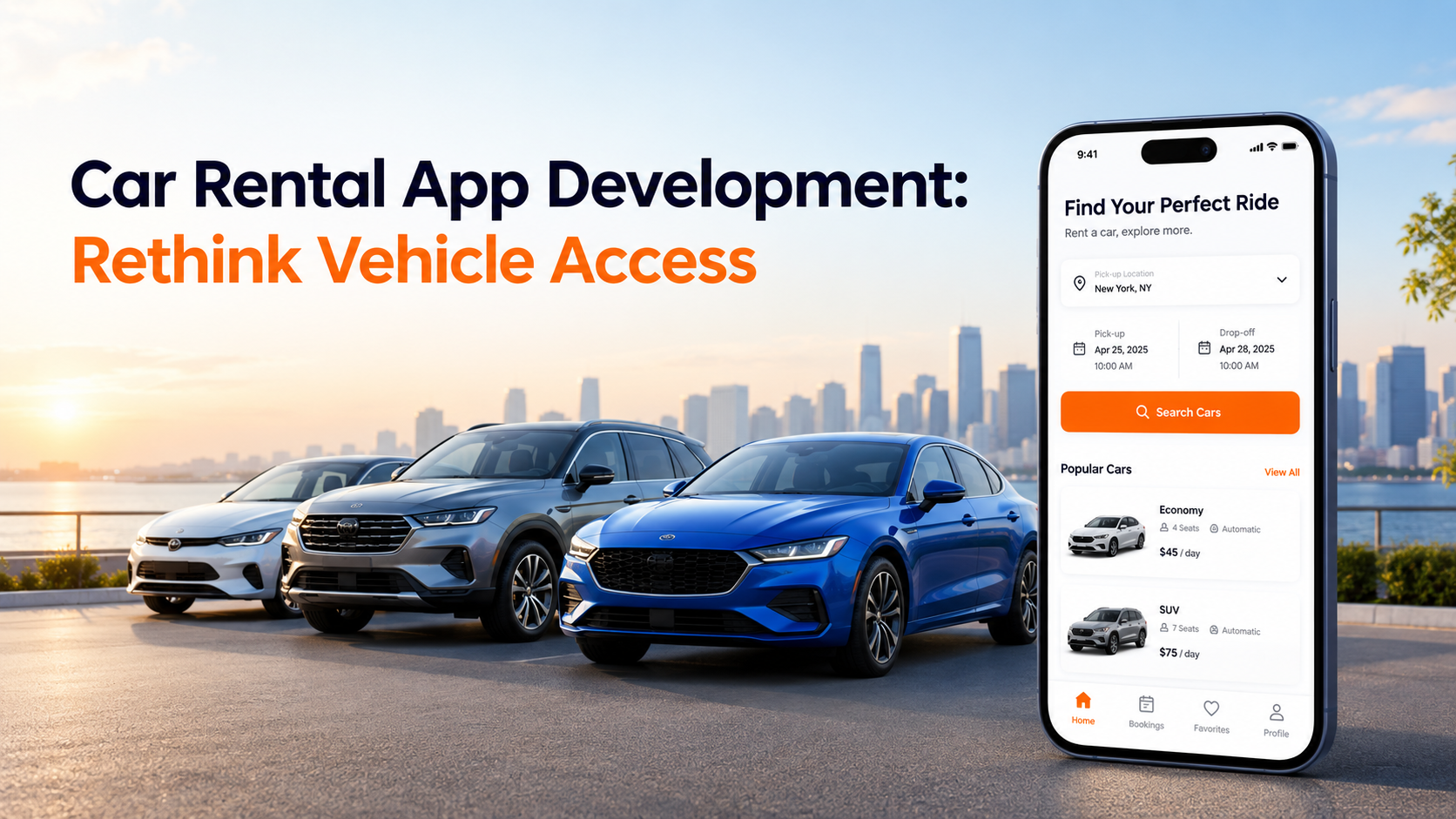
Customers do not necessarily want to “rent a car.” They want to get a vehicle when they need one without wasting time on paperwork, queues, phone calls, or complicated pickup processes. That shift is making car rental app development increasingly important for businesses looking to create faster, more flexible vehicle-access experiences.
The traditional rental journey often depends on fixed counters, manual verification, physical documents, and staff coordination. Modern customers expect something different: discover a vehicle nearby, check availability, verify their identity, reserve it, complete payment, and receive clear pickup instructions from one digital journey.
For rental startups, this creates an opportunity to compete on convenience rather than fleet size alone.
Car Rental App Development for Frictionless Rentals
The rental experience begins before the customer reaches the vehicle.
A potential renter wants immediate answers: What vehicles are available? Where are they located? How much will the rental cost? What documents are required? Can the booking be extended? What happens if plans change?
A well-designed rental platform can bring these decisions into one streamlined experience.
Instead of making customers navigate multiple steps, businesses can build workflows around:
-
real-time vehicle availability
-
digital identity verification
-
automated booking confirmation
-
secure online payments
-
digital rental agreements
-
location-based vehicle discovery
-
pickup and return instructions
-
rental extension requests
-
digital inspection records
-
automated notifications
The important distinction is that these features should work together as one rental journey.
For example, availability information should connect with booking logic. Booking status should connect with payment. Vehicle status should connect with pickup and return workflows. Inspection records should remain associated with the specific rental.
This connected approach can reduce operational gaps that often appear when rental businesses rely on separate systems.
Self-Service Mobility Is Creating New Rental Opportunities
The move toward self-service does not mean removing people from the rental business entirely.
It means allowing technology to handle repetitive interactions while staff focus on exceptions, fleet operations, customer issues, and higher-value activities.
For suitable business models, mobile-first rentals can support faster pickup and return processes. Location technology can help customers identify the correct vehicle or pickup point. Automated reminders can reduce late returns. Digital inspection workflows can create a documented record of vehicle condition before and after a rental.
These improvements can become particularly valuable as rental operators expand into multiple locations.
Managing ten vehicles from one location is very different from coordinating hundreds of vehicles distributed across airports, hotels, residential areas, business districts, and other pickup zones.
A centralized platform can give operators visibility across the network without requiring every booking to pass through manual coordination.
Build Around the Complete Rental Lifecycle
One of the biggest mistakes in rental technology is treating the booking as the end goal.
The booking is only one stage.
The actual lifecycle includes vehicle preparation, customer verification, pickup, active rental, extensions, return, inspection, maintenance, and reavailability.
Car rental app development can connect these stages.
When a customer returns a vehicle, for example, the system can trigger an inspection workflow. If the vehicle requires maintenance, its availability can be updated accordingly. Once it is ready, the vehicle can automatically become visible for future bookings.
This creates a continuous operational loop.
The same principle can apply to vehicle extensions. If a customer requests additional rental time, the platform can check whether another reservation is approaching before confirming the extension.
These seemingly small workflow connections can have a major effect when rental volumes increase.
From Rental Bookings to Mobility Relationships
Another emerging opportunity is moving beyond one-off rentals.
A customer who rents frequently may prefer personalized access rather than repeatedly starting the entire rental process. Businesses can introduce loyalty programs, preferred vehicle categories, corporate accounts, subscription packages, recurring rentals, or personalized offers.
This allows the platform to build a relationship with the customer rather than treating every rental as an isolated transaction.
Rental operators can also use behavioral data to understand customer preferences. A frequent airport renter may respond to airport-focused offers. A weekend customer may be interested in flexible two-day packages. A corporate customer may need centralized billing and multiple authorized drivers.
The technology can make these differences actionable.
Build the Digital Layer Behind Modern Car Rental
The future of rental businesses is not simply about putting vehicles online.
It is about removing unnecessary friction from every interaction surrounding vehicle access.
A strategically developed car rental platform can help businesses simplify customer journeys, coordinate distributed fleets, automate repetitive operations, and create new rental models without rebuilding their technology every time the business expands.



 English
 Slovenčina
 Deutsch