
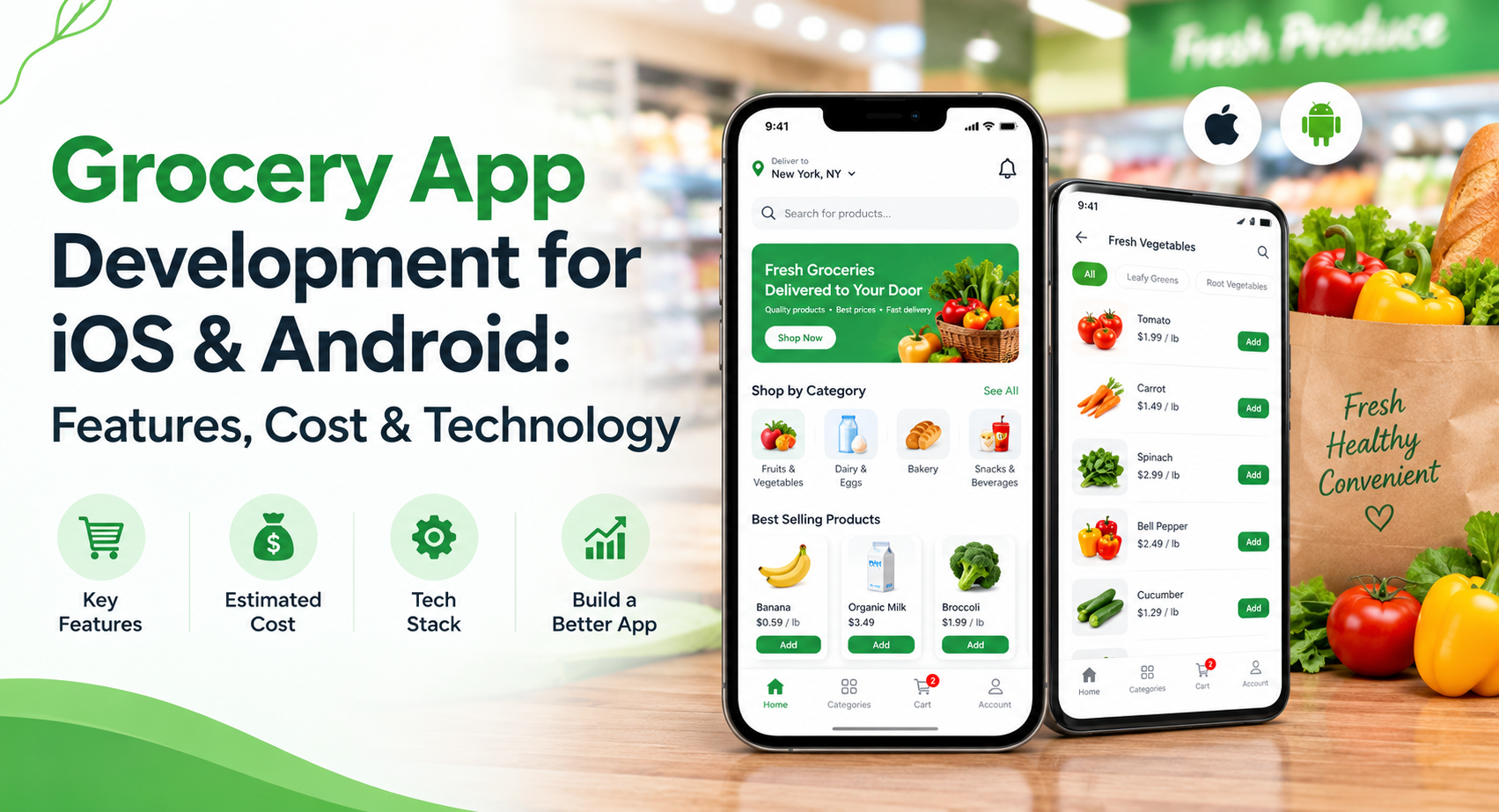
Grocery shopping is rapidly moving from physical aisles to digital storefronts. Consumers increasingly expect convenient ordering, flexible delivery slots, transparent pricing, and real-time order visibility from their smartphones.
For businesses, this shift creates an opportunity to establish scalable grocery delivery platforms for both iOS and Android. A well-engineered grocery application can connect customers, retailers, inventory systems, and delivery partners within one cohesive digital ecosystem.
What Is Grocery App Development for iOS and Android?
Grocery app development involves creating mobile applications that enable customers to discover products, add items to their carts, place orders, make payments, and track deliveries.
A complete ecosystem generally consists of a customer application, store or vendor panel, delivery partner application, and admin dashboard. Each component serves a distinct operational purpose while communicating through a centralized backend.
Cross-platform frameworks can also help businesses streamline development across iOS and Android while maintaining a consistent user experience.
Essential Features of a Grocery Delivery App
The customer application should provide intuitive product discovery, category browsing, search, filters, shopping carts, wishlists, multiple payment options, order scheduling, and delivery tracking.
The store panel enables retailers to manage product catalogs, prices, inventory, promotions, incoming orders, and fulfillment status.
Delivery partners require features for registration, order acceptance, navigation, availability management, earnings tracking, and delivery confirmation.
Meanwhile, the admin dashboard provides centralized control over users, stores, drivers, orders, commissions, payments, promotions, and analytics.
Advanced Features for a Competitive Grocery Platform
Modern grocery applications can transcend basic ordering functionality through intelligent automation.
AI-powered recommendations can analyze customer behavior and suggest relevant products. Smart inventory tools can monitor stock levels and help businesses anticipate replenishment requirements.
Real-time GPS tracking provides delivery visibility, while personalized discounts and promotional campaigns can encourage repeat purchases. Subscription plans, scheduled deliveries, loyalty programs, and multiple-store ordering can further enrich the platform.
Technology Stack for Grocery App Development
The technology stack depends on the application's complexity, scalability requirements, and business model. Mobile applications can be developed using native technologies or cross-platform frameworks.
The backend typically manages authentication, orders, inventory, payments, notifications, and business logic. Cloud infrastructure can provide elastic scalability as transaction volumes increase.
Third-party APIs can support maps, geolocation, payment processing, SMS, push notifications, analytics, and authentication. A robust database architecture is equally important for maintaining product, customer, order, and inventory information efficiently.
Grocery App Development Cost
The cost of grocery app development varies considerably. An MVP with fundamental ordering and delivery functionality requires a smaller investment than a sophisticated marketplace containing AI, advanced analytics, multi-store operations, and extensive automation.
Major cost factors include platform selection, UI/UX complexity, number of applications, feature requirements, backend architecture, integrations, development team location, security requirements, and ongoing maintenance.
Businesses should therefore define their essential features first and progressively introduce advanced capabilities as the platform gains traction.
Steps to Develop a Grocery Delivery App
The process typically begins with market research and business-model definition. Next comes feature planning, UI/UX design, technology selection, development, API integration, and quality assurance.
After testing performance, security, payments, and usability, the application can be deployed to the respective app stores. Continuous analytics and customer feedback can then guide subsequent updates and feature enhancements.
Conclusion
Grocery app development for iOS and Android requires more than a digital shopping interface. A successful platform combines intuitive customer experiences with efficient inventory, store, delivery, payment, and administrative operations. With the right architecture and scalable feature strategy, Spotneats can help businesses build a modern grocery delivery ecosystem designed for sustainable digital growth.


 English
 French
 Deutsch