

introduction
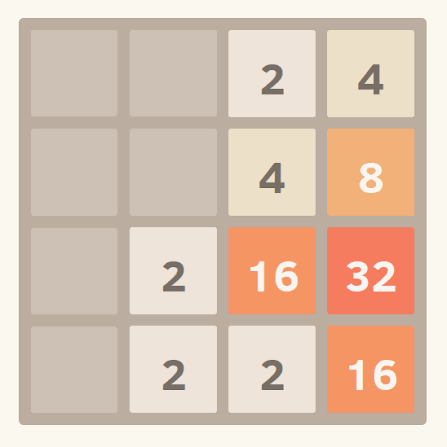
The 2048 game is a popular number-based puzzle game that combines mathematics, logical thinking, planning, and entertainment. Since its introduction in 2014, it has attracted millions of players around the world because of its simple rules and challenging gameplay. Although the game appears easy at first, achieving a high score requires careful thinking, patience, and strategic decision-making. The main objective is to combine numbered tiles on a grid until a tile with the value of 2048 is created. However, reaching this goal is not as simple as it sounds. Every movement changes the arrangement of the board, and one careless decision can make it difficult or even impossible to continue playing successfully.
The popularity of 2048 demonstrates how a simple idea can become an engaging digital experience. Unlike many modern video games that require advanced graphics, complicated controls, or expensive equipment, 2048 can be played on a basic computer, smartphone, or tablet. Its straightforward design makes it suitable for people of different ages and backgrounds. At the same time, its mathematical structure provides an interesting challenge for players who enjoy solving problems. This essay explores the history, rules, mathematical foundations, strategies, benefits, challenges, and educational value of the 2048 game.
1. History and Development of the 2048 Game
The 2048 game was created by Italian developer Gabriele Cirulli in March 2014. He developed it as a personal project and released it as a free browser-based game. The original version was inspired by earlier puzzle games, particularly Threes!, which also involved combining numbered tiles. Cirulli designed 2048 to be simple, accessible, and enjoyable without requiring players to pay for it.
The game became extremely popular shortly after its release. Its success spread rapidly through social media, online gaming communities, and word-of-mouth recommendations. Many people enjoyed sharing their scores and challenging friends to achieve the 2048 tile. The game's popularity also encouraged developers to create mobile applications and different versions with alternative designs and features.
One important reason for its success was its accessibility. Players did not need to create an account, purchase expensive equipment, or learn complicated instructions. They could simply open the game and start playing. The original version was also open-source, allowing other developers to study its code and create their own variations.
Over time, 2048 became more than just a casual puzzle. It developed into an example of how effective game design can combine simplicity and complexity. Its rules are easy to understand, but the challenge increases as players attempt to manage more tiles and limited space.
2. Basic Rules and Gameplay
The traditional 2048 game is played on a square grid containing sixteen spaces arranged in four rows and four columns. At the beginning of the game, two numbered tiles usually appear on the board. Most tiles contain either the number 2 or 4.
The player controls the tiles using four possible movements: up, down, left, and right. Whenever a direction is selected, all movable tiles slide as far as possible toward that side of the grid.
When two tiles with identical numbers collide during a movement, they combine into a single tile whose value is twice the original number. For example, two tiles containing 2 combine to create 4, while two tiles containing 8 combine to create 16.
After each valid move, a new tile usually appears in an empty space. This new tile generally has a value of 2 or, less frequently, 4. As the game continues, the board gradually becomes more crowded.
The main objective is to create a tile containing the number 2048. However, players can continue playing after reaching this milestone in versions that support continued gameplay.
The game ends when there are no empty spaces and no adjacent tiles with matching values that can be combined. At this point, the player has no available moves.
Although these rules are relatively simple, the game requires players to think several steps ahead. Every movement affects the entire board, making each decision important.
3. Mathematical Foundations of 2048
Mathematics is one of the most important elements of the 2048 game. The numbers on the board follow a pattern based on powers of two. Each successful combination doubles the value of a tile.
The sequence of numbers commonly found in the game is:
2, 4, 8, 16, 32, 64, 128, 256, 512, 1024, and 2048.
This sequence can be expressed mathematically as:
Therefore, the number 2048 is equal to:
This means that eleven powers of two are required to reach the target value from the starting value of 2.
The process of combining tiles also demonstrates exponential growth. Each time two identical tiles merge, their value doubles. For example:
-
Two 2 tiles produce 4.
-
Two 4 tiles produce 8.
-
Two 8 tiles produce 16.
-
Two 16 tiles produce 32.
-
Two 32 tiles produce 64.
This pattern continues until the player reaches 2048.
Another interesting mathematical feature is conservation of the total numerical value. When two tiles combine, their values are added together. For example, combining two 16 tiles produces a 32 tile. The total value remains 32 before and after the combination.
The appearance of new tiles increases the total numerical value on the board. Consequently, the game combines addition, multiplication, powers, and probability in an interactive environment.
These mathematical principles make 2048 an enjoyable way to explore numerical patterns and basic arithmetic.
4. Strategies for Winning the Game
Although luck plays a role in 2048 because new tiles appear in different locations, successful players rely heavily on strategic planning. Developing an effective strategy can greatly improve the chances of reaching the target.
Keeping the largest tile in one corner
One of the most popular strategies is to keep the largest tile in a fixed corner, such as the bottom-right or bottom-left corner. This approach helps organize the board and prevents the largest tile from moving randomly.
Players then arrange smaller tiles around the largest tile in descending order. This creates a structured pattern that makes combinations easier.
Choosing a preferred direction
Another useful strategy is to select two main movement directions and avoid unnecessary movements in the opposite directions. For example, a player who keeps the largest tile in the bottom-right corner might mainly use the right and down movements.
This reduces the possibility of accidentally moving the largest tile away from its intended position.
Planning several moves ahead
Players should not focus only on the immediate result of a movement. Instead, they should consider how the board might look after the next two or three moves.
For example, moving a row of tiles to the left might create an immediate combination, but it could also separate two important tiles that would otherwise combine later.
Maintaining empty spaces
Empty spaces are extremely valuable in 2048. They provide room for movement and allow new tiles to appear without blocking important combinations.
Players should avoid filling the board unnecessarily. Combining smaller tiles whenever possible helps maintain enough empty spaces for future movements.
Combining smaller tiles first
Another effective approach is to organize smaller tiles before attempting to combine larger ones. This creates a more orderly board and makes it easier to build larger numbers gradually.
Overall, the best strategy involves balancing short-term combinations with long-term planning.
5. The Role of Logic and Problem-Solving
The 2048 game is not simply about moving numbers randomly. It is a puzzle that requires logical thinking and problem-solving skills.
Every move presents a decision. Players must examine the current arrangement of tiles, identify possible combinations, and predict the consequences of different movements.
For example, a player may have three possible choices: move left, move down, or move right. Each choice produces a different arrangement of the board. The player must determine which movement creates the greatest opportunity for future combinations.
This process is similar to solving mathematical problems. A person identifies the available information, evaluates different possibilities, and selects the most appropriate solution.
The game also encourages flexible thinking. Sometimes a strategy that works well at the beginning becomes ineffective later because the board becomes crowded. Players must recognize these changes and adjust their approach.
In addition, 2048 encourages players to learn from mistakes. When an unsuccessful move causes the board to become disorganized, players can examine what happened and avoid making the same decision in future games.
For these reasons, 2048 can be considered an enjoyable exercise in logical reasoning and decision-making.



 English
 French
 Deutsch